
There are many supplements and vitamins out there. So many that I don’t know about you, but it can make your head spin trying to understand all of them. When I was first diagnosed, the doctor discussed with me that I should add daily supplements in with the changes in the diet. However, the supplements that I was to add in were completely dependent on different symptoms that I had. He explained to me that there were supplements that were for everyone with autoimmune diseases regardless of what autoimmune disease you have. There were also supplements for inflammation, gut health, yeast, infections, detox, parasites, adrenal, bacteria in the intestine, etc.
In the last couple of podcasts and blog posts, I have talked at length about gut health and how important it is to heal your gut or to not have leaky gut syndrome when trying to fight the autoimmune symptoms. Because of my digestive issues, this was one of the first things that my rheumatologist brought up in terms of supplements. He had me complete a few questionnaires and answer some questions to see if I had yeast overgrowth and small intestine bacterial overgrowth or SIBO. He also had me tested for parasites. Not everyone is going to want to use or even need the same supplements. They are going to be different dependent upon what your specific needs are. There are some great questionnaires in The Autoimmune Solution by Amy Myers that were very similar to what my doctor gave me in order to determine exactly what it was that I needed to take.
Let’s start with yeast overgrowth. Yeast generally lives in the mouth, the throat, the gut, and the vagina and usually does not cause any problems. However, when there is an overgrowth of yeast in a person’s body, it can create symptoms such as tiredness and fatigue, digestive issues, sinus issues and infections, skin and nail fungal infections, and joint pain. If you suffer from an autoimmune disease, a lot of these symptoms are similar meaning that it is just going to make things worse. It is going to make your symptoms worse and make you feel worse. How do you figure out if you have yeast overgrowth? Here are a few questions, if you answer yes to two or more, you most likely have yeast overgrowth.
- Do you have an autoimmune disease such as Hashimoto’s, rheumatoid arthritis, lupus, colitis, etc.?
- Do you suffer from digestive issues?
- Do you suffer from seasonal allergies?
- Do you suffer from skin issues?
- Do you suffer from mental health issues, such as anxiety, depression, mood swings, ADD, ADHD, brain fog, cognitive deficiencies?
- Do you have chronic fatigue or are you tired all the time?
- Do you get sugar cravings or carbohydrate cravings?
What about SIBO? If you answer yes to two or more of the following questions, you most likely have small intestine bacterial overgrowth (SIBO).
- Do you have loose stools with overwhelming odor?
- Do you have food intolerances?
- Have you been diagnosed with irritable bowel syndrome or inflammatory bowel disease?
- Do you have digestive issues such as gas, bloating, abdominal pain, or cramping?
- Are you overly tired?
- Do you have respiratory issues?
- Do you have achy joints?
- Do you suffer from skin issues?
If you have yeast overgrowth or SIBO, you will want to take supplements and make dietary changes in order to starve the yeast and the bacteria. A lot of times when we have one, we have the other; however, the supplements are not the same for both so it is always good to go get tested for both.
If you have yeast overgrowth, two great supplements are caprylic acid and candisol. Caprylic acid is believed to have many benefits including antibacterial, antifungal, and anti-inflammatory properties. These benefits are useful in managing yeast overgrowth, skin conditions, digestive issues, and even high cholesterol. If you do not want to take caprylic acid as a supplement, you can ingest coconut oil to still be able to reap the benefits. Most people start with adding 1 tablespoon or less each day. Candisol is a product that is a combination of digestive enzymes which are then used to break down the cell wall of the Candida cells.
There are many great supplements to take for SIBO as well as some actual antibiotics. Some do not want to take actual antibiotics, so herbal antibiotics are the way that some lean towards. However, these can cause GI side effects as not all herbal supplements are tolerated by everyone. The most studied option is Metagenics Candibactin-AR and Candibactin-BR or Biotics FC Cidal and Dysbiocide. Other options include Allimax, Berberine Complex, Neem Plus, MicrobClear and Oil of Oregono. Again, most of these are antifungal, antimicrobial, and antivirals.
Now onto other supplements specifically for autoimmune diseases. Some of the ones that my doctor recommended for everyone regardless of autoimmune disease or symptoms include:
- Probiotic – which is made up of good bacteria that helps keep your body healthy which includes fighting off the bad bacteria and making up a healthy microbiome. My favorite probiotics include Klaire/ProThera, Garden of Life, and Digestive Advantage.
- Omega-3 fish oil – helps muscle activity and cell growth as well as rheumatoid arthritis, high cholesterol, and heart disease. I actually take krill oil because I cannot swallow large pills. Because of that, I cannot give full recommendations, but Metagenics is what was recommended to me.
- Gut repair powder or L-glutamine – This is to help with leaky gut, digestion, and to help restore gut health. This is to help maintain a healthy intestinal lining, soothe the GI tract, and support collagen repair. My favorite is Leaky Gut Revive by Amy Myers or Xymogen, but I prefer the Leaky Gut Revive as it comes in two flavors – unflavored which I put in my smoothies or strawberry lemonade which I put in my water and it adds a great taste. I have not tried any of the L-glutamine as it comes in the leaky gut revive and then I do not have to take a pill, but my rheumatologist recommended Designs for Health.
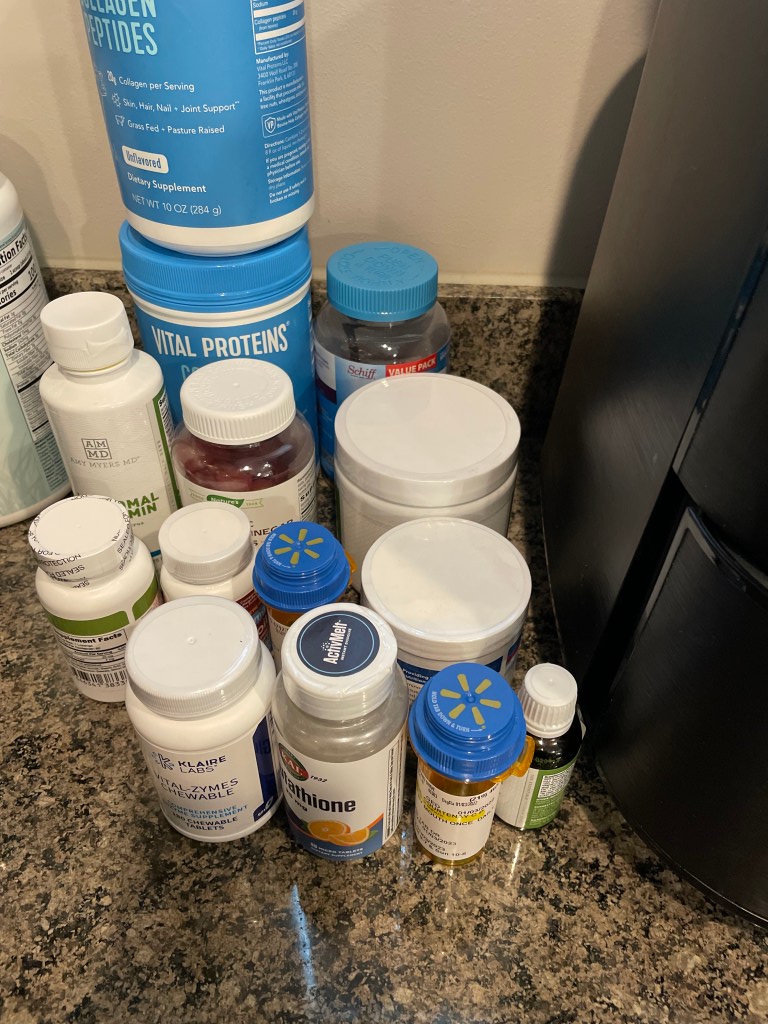
- Glutathione – This is essential for our immune system’s proper functioning as well as building and repairing tissue. Glutathione is a very important antioxidant that is also very good for anti-aging. My favorite is KAL L-Glutathione, which is a melting tablet that you put under your tongue. Another one that I liked but couldn’t swallow well was CitriSafe.
- Vitamin D3 – This is just an important supplement for overall health regardless of an autoimmune disorder. However, when you have too little, it can affect your joints, bones, muscles, as well as your immune system and the inflammation in your body. I prefer vitamin D drops that are taken under your tongue. The best one I have found in terms of price, taste, use, etc. is Pure Encapsulations.
Other supplements that were recommended to me include Curcumin and Resveratrol for inflammation and immune support. Curcumin is a natural anti-inflammatory compound that helps fight foreign invaders and repairs damage that reduces inflammation. I prefer Amy Myers Liposomal Curcumin as it also helps with gut health and doesn’t taste bad. A lot of the curcumin that I have tried does not taste good, but Amy Myers doesn’t taste bad. It is like a thick orange juice. If you prefer pills, Thorne Research has a great one that are capsules. Resveratrol is thought to act like an antioxidant that can protect the body against damage including anti-aging and disease-fighting powers. A lot of resveratrol is found in the skin of red grapes. I have only tried one and that is CitriSafe Resveratrol which is a dissolvable pill under the tongue.
Supplements for gut health include adding in collagen. I love Vital Proteins Collagen as it is easy to put in anything without any taste. Additionally, digestive enzymes are a good supplement addition as well. Klaire Labs digestive enzymes are wonderful and actually help a lot when there are inflammatory foods hidden in my meals. For example, if I accidentally eat gluten or dairy in something, it will keep me from being very ill.
I know that this sounds like a lot of supplements to take and it definitely is, but the improvement that I have seen has been great. I do recommend that you not start all of the supplements at one time. If you have any issues with any of them, you will not be able to figure out exactly which one is causing issues. While they are natural supplements and are for healing, this doesn’t mean that you will not have any side effects. Once you have figured out exactly what you want to take and what works for you, I recommend a pill caddy. I have one that is for AM, afternoon, and PM. At each one I take them with my meals. For some, you might need one that has four slots as there will be supplements that you take on an empty stomach. For me, the only supplement that I take on an empty stomach is my curcumin. I take that first thing in the morning as soon as I wake up. I then put all of my powders (collagen, leaky gut revive, and lysine – which I take because I get cold sores very often) in with my smoothie, but I wait an hour and a half to blend and drink that. With my smoothie I also take digestive enzymes, glutathione, and probiotics. At lunch, I take just digestive enzymes, and at dinner, I take digestive enzymes, resveratrol, krill oil, and vitamin D3 drops. There are some great charts on supplements in The Autoimmune Solution by Amy Myers if you are looking for more information.

 the autoimmune professor
Leave a comment